

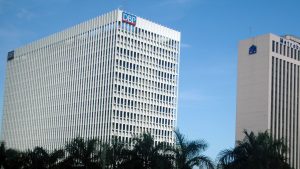
THE DEVELOPMENT Bank of the Philippines (DBP) is planning to seek dividend and regulatory relief again from the central bank to rebuild its capital, its top official said.
DBP President and Chief Executive Officer Michael O. de Jesus said the bank wants to recoup the seed capital it provided for Maharlika Investment Corp. (MIC).
“Our goal is to build up our capital,” he told reporters on the sidelines of an event on Thursday. “We’ve had dividend relief for the past maybe seven years.”
In 2019, DBP was exempted from remitting its dividend to the government for its 2017 earnings after its dividend rate was slashed to 0% from 50%.
It was likewise granted dividend relief for its 2022 income after President Ferdinand R. Marcos, Jr. signed an executive order as compensation for its contribution to the MIC.
Republic Act No. 7656 or the Dividends Law mandates government-owned and -controlled corporations to remit dividends equivalent to at least 50% of their earnings to the National Government.
“We need to build up as a bank. That’s why we’re asking (for) dividend relief, especially so we can recover,” he added. “Remember, the bank lost P25 billion to Maharlika. So, we need to build up our capital base.”
In September 2023, DBP injected P25 billion into the MIC for the sovereign wealth fund’s initial seed capital, while Land Bank of the Philippines (LANDBANK) contributed P50 billion.
According to Mr. De Jesus, DBP has about P97 billion in total equity, up from the around P80 billion it had three years ago.
The DBP chief said they are bullish about the MIC despite the slow progress of its investments.
“They have a long pipeline of investments. No investment yet. They took time to set it up and all that,” he said. “But they have good people in Maharlika. We’re confident it will do well.”
Mr. De Jesus said DBP will again request for dividend relief for the next five to seven years, including this year, as well as regulatory relief for 2025.
He added that they target to exit regulatory relief in two years.
In an earlier report, the International Monetary Fund called for the restoration of capital for DBP and LANDBANK after their contributions to the MIC.
The IMF noted the importance of capital restoration and exiting regulatory relief “as soon as possible.”
The Finance department has pushed for the amendments to DBP’s decades-old charter to strengthen its financial position and give it easier access to the capital markets.
Mr. De Jesus earlier said they could push for the passage of a new DBP charter in this Congress after the previous proposal approved by the 19th Congress was vetoed by Mr. Marcos in May.
The proposed charter amendments include provisions that would increase its capital stock to P300 billion from P35 billion to help finance its priority sectors, such as social infrastructure and small businesses, and allow it to offer up to 30% of its shares to the public, with the National Government mandated to own 70% of its capital stock at all times.
Several measures are now pending at the committee level at both the House and the Senate.
Fitch Ratings said in January that the charter changes could help support the state-run lender’s capital restoration following its contribution to the country’s sovereign wealth fund and boost its credit profile.
DBP’s net income fell by 51.77% year on year to P2.257 billion in the first nine months of 2025.
Mr. De Jesus said the bank’s net income might be cut by P1 billion to P2 billion by yearend due to higher provisioning and as the ongoing graft scandal has slowed down contractors’ repayments. Still, he sees DBP recovering by the first quarter of 2026. — Katherine K. Chan