

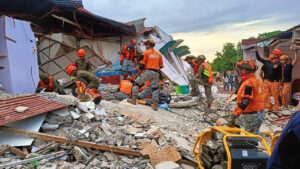
There is no shortage of stories celebrating Filipino resilience. After every storm, flood, or earthquake, we see familiar scenes: families wading through chest-deep waters while smiling for the cameras, neighbors sharing rice and coffee in candlelight, and children turning evacuation centers into playgrounds. It is a powerful image of courage and optimism, a cultural badge of honor.
But over the years, that badge has become dangerously convenient for those who should be held accountable. “Resilience” has become the language of survival in a country where too many public works projects fail the people they were meant to protect. It has become a convenient narrative that praises endurance while excusing negligence.
Resilience, in its purest form, is a virtue. It reflects the Filipino’s ability to adapt, recover, and rebuild. But when used by policymakers and corporate actors as a shield against accountability, resilience turns toxic. It becomes an institutional comfort zone that normalizes substandard performance and diverts public outrage.
The truth is, Filipinos should not have to be resilient all the time. A truly resilient nation is one that does not need to test its citizens’ endurance every year. Real resilience lies not in how quickly people recover from disaster but in how well the system prevents avoidable suffering in the first place.
WHERE RESILIENCE MEETS ROTThe current flood control scandal exposes the cracks, literal and figurative, in our public infrastructure system. Senate hearings have revealed that several flood control projects, worth billions in public funds, were implemented using substandard materials, questionable procurement processes, and in some cases, were never completed at all.
According to testimony before the Senate Blue Ribbon Committee, contractors allegedly colluded with public officials to pad budgets and deliver half-baked work. Auditors also flagged numerous projects that lacked completion reports or were non-existent despite full disbursement of funds.
The consequences are real. When torrential rains hit Bulacan, Pampanga, and parts of Metro Manila last month, several newly built dikes and drainage systems failed to hold. Entire barangays went underwater again. People lost homes, livelihoods, and loved ones. Yet government officials were quick to praise communities for their “resilience.”
Resilience should never be the consolation prize for corruption.
When government and private-sector leaders celebrate resilience without fixing the root causes of suffering, they shift the burden from the state to the citizen. “Filipinos are resilient” becomes shorthand for “Filipinos can handle it.” It is an elegant way to avoid saying, “We failed you.”
This misplaced admiration also corrodes accountability. It allows politicians to under-deliver, contractors to overcharge, and agencies to overlook poor workmanship because the public, time and again, finds ways to survive.
When endurance becomes an expectation, resilience ceases to be a strength. It becomes systemic abuse.
RESILIENCE AS MORAL HAZARDIn risk management, a moral hazard occurs when someone takes greater risks because they do not bear the full consequences of failure. In our case, institutions take moral hazards when they rely on the people’s resilience to cushion the impact of their incompetence.
This mindset infects both the public and private sectors. Local governments underinvest in maintenance because they expect communities to self-organize during floods. Contractors take shortcuts knowing that post-disaster relief will cover their deficiencies. National agencies promise to “study” the problem anew after each calamity instead of fixing the root causes.
In other words, resilience becomes policy by default, not by design.
Poor infrastructure is not only a humanitarian concern. It is an economic drag. Studies by the World Bank and National Economic and Development Authority (NEDA), now the Department of Economy, Planning, and Development, have shown that climate- and disaster-related disruptions consistently shave off growth by damaging assets, displacing workers, and interrupting logistics and power supply. Flooding alone regularly paralyzes commerce in major cities, reducing productivity, and inflating the cost of doing business.
When roads, bridges, and flood control structures repeatedly fail, the cost compounds. Businesses lose inventory, insurers raise premiums, and investors hesitate to expand in vulnerable areas. The private sector ends up paying for the government’s negligence, and consumers pay for it twice: through taxes and higher prices.
The irony is that infrastructure is supposed to be the backbone of national competitiveness. When that backbone is weak, the country spends more time surviving than thriving.
INTEGRITY, NOT IMPROVISATIONIf the Philippines wants to move from survival to sustainability, it must redefine resilience. True resilience is built on three foundations: integrity, accountability, and foresight.
Integrity in construction means that every bridge, dike, and drainage system must meet the standards promised in the contract, not just on paper but on the ground. It means an end to the pwede na mentality that still dominates public works.
Accountability requires that public officials, project engineers, and contractors face consequences for negligence and fraud. Investigations must lead to convictions, not just headlines. Otherwise, the cycle repeats.
Foresight demands planning beyond the political term. Flood control systems, for instance, must be designed with climate projections in mind, not merely for ribbon-cutting ceremonies before elections.
The private sector has a crucial stake in this issue. Companies that benefit from government contracts must uphold the highest standards of engineering and ethics. Cutting corners is not merely a crime. It is a reputational and financial liability.
Moreover, industries that depend on logistics, real estate, and tourism cannot thrive in an environment where infrastructure collapses with every storm. Businesses must therefore lend their voice to demand better governance, not as charity or corporate social responsibility, but as enlightened self-interest.
A resilient economy is impossible without reliable infrastructure. Reliable infrastructure is impossible without ethical leadership.
FROM RESILIENT PEOPLE TO RESILIENT SYSTEMSWe must retire the narrative that resilience lies solely in the Filipino spirit. The real test of a nation’s resilience is not in how people smile through suffering but in how the system prevents that suffering in the first place.
This means redefining “resilience” from a cultural trait into a structural outcome. It means building floodways that work, drainage that lasts, power lines that hold, and housing that withstands storms. Not because people are used to rebuilding, but because they deserve not to.
It also means reimagining leadership. The best leaders do not wait for calamity to showcase compassion. They design systems so effective that compassion becomes less necessary.
For decades, the Filipino people have carried the weight of the nation’s resilience narrative. It is time for institutions to carry their share. Policymakers must craft budgets that prioritize maintenance over monuments and results over ribbon-cuttings. Regulators must professionalize public-works oversight and ensure that projects are independently audited and verified.
Civil society and the media must continue to expose corruption in infrastructure, not as scandal but as systemic risk. Citizens must demand transparency, from bidding documents to completion certificates.
Resilience, if reclaimed properly, can become a shared ethic of responsibility: citizens who cooperate, companies that build with integrity, and a government that delivers without excuse.
The floods will come again. The question is whether we will have learned.
If the only thing we build better after every disaster is the myth of Filipino resilience, then we have failed. But if we build structures that stand, systems that work, and a culture that demands nothing less, then resilience will finally mean what it should: not survival amid failure, but strength through accountability.
Resilience is not policy. It is a promise. And it is time our leaders, both in government and in business, kept it.
Dr. Ron F. Jabal, APR, is the CEO of PAGEONE Group (www.pageonegroup.ph) and founder of Advocacy Partners Asia (www.advocacy.ph).