

By Katherine K. Chan
MONEY SENT HOME by Filipinos abroad grew by 3% year on year in October, the slowest pace in five months, the Bangko Sentral ng Pilipinas (BSP) said on Monday.
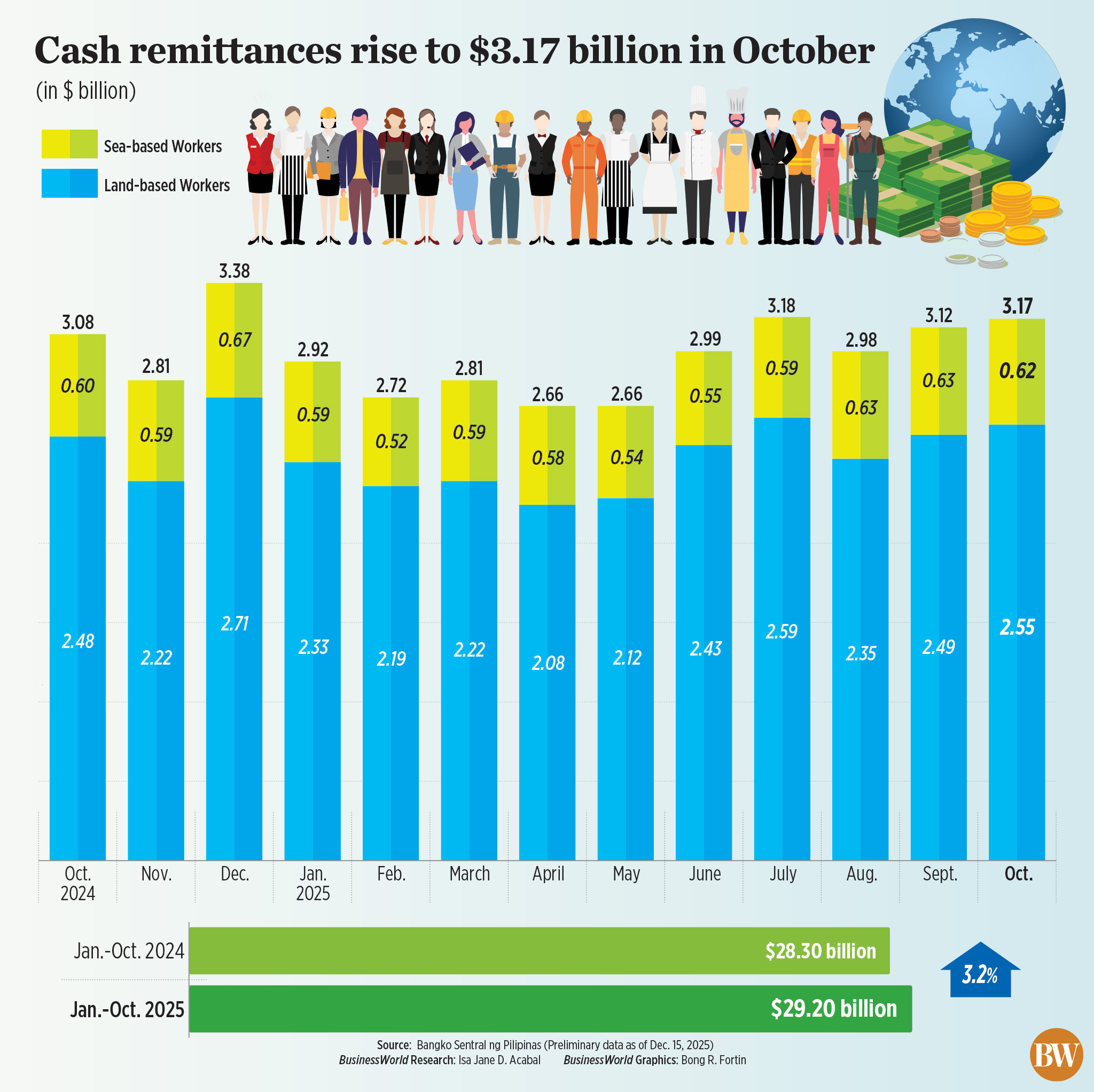
Cash remittances coursed through banks climbed to $3.171 billion from $3.079 billion in the same month last year, data from the central bank showed.
This was the slowest growth since May when remittances rose by 2.9%. It also matched the 3% growth in July.
In terms of amount, October had the highest monthly remittance level in three months or since the $3.179 billion logged in July.
“Cash remittances from overseas Filipinos totaled $3.17 billion in October 2025 and $29.2 billion in January-October 2025,” the central bank said in a statement.
Month on month, remittances grew by 1.6% from $3.121 billion in September.
“Growth was driven by steady overseas employment and seasonal transfers ahead of the holidays, with the US accounting for over 40% of inflows,” Union Bank of the Philippines Chief Economist Ruben Carlo O. Asuncion said in a Viber message.
“While October marked the slowest pace in five months, this reflects timing rather than a structural slowdown.”
Rizal Commercial Banking Corp. Chief Economist Michael L. Ricafort said the peso trading at the P58 to P59-per-dollar level benefited overseas Filipino workers (OFW) who sent remittances in October.
“The relatively higher US dollar-peso exchange rate at P58-P59 levels in recent months amid the political noises especially in September…, was an opportunity for some OFWs and their families or dependents to convert remittances to pesos to finance their various expenditures in the country,” he said in a Viber message.
In October, the peso performed weaker against the greenback at an average of P58.2984 per US dollar from the P57.2501 recorded in September.
Jonathan L. Ravelas, a senior adviser at Reyes Tacandong & Co., said high labor demand and pre-holiday preparations helped sustain the annual growth in remittances.
He also noted that the slowdown in October was a trend typically observed before remittances hit their highest level by yearend.
“The slower October pace isn’t alarming — it’s a typical lull before the year-end surge, and the weak peso actually gives OFWs more bang for their buck,” Mr. Ravelas said in a Viber message.
Money sent home by land-based workers went up by 2.98% to $2.55 billion in October from $2.476 billion in the same month in 2024.
On the other hand, remittances from sea-based migrant workers grew by 3.11% to $621.113 million in October from $602.35 million a year ago.
Meanwhile, personal remittances, which include both cash coursed through banks and informal channels and in-kind remittances, rose by 3% to $3.519 billion in October from $3.415 billion a year earlier.
10-MONTH REMITTANCESIn the 10-month period, cash remittances reached $29.202 billion, up 3.2% from the $28.304 billion seen a year ago.
This is slightly faster than the BSP’s 3% full-year growth forecast. The BSP expects to end the year with $35.5 billion in total cash remittances.
However, Mr. Asuncion said remittance inflows will likely increase in the remaining two months of the year.
“It is important to note that OFW remittances and conversion to pesos seasonally accelerate, if not peak, in (the fourth quarter) especially during the Christmas holiday season towards the end of the year,” Mr. Ricafort said.
Personal remittances grew by 3.2% annually to $32.493 billion in the January-to-October period from $31.487 billion a year ago.
BSP data also showed that remittances from land-based OFWs edged up by 3.28% year on year to $23.36 billion from $22.618 billion in 2024.
Meanwhile, sea-based Filipinos have sent home a total of $5.841 billion at end-October, 2.73% higher than the $5.686 billion recorded in the comparable year-ago period.
As of October, OFWs in the United States sent the most money home, accounting for 40.3% of the total cash remittances during the period.
This was followed by Singapore (7.2%), Saudi Arabia (6.4%), Japan (4.9%), the United Kingdom (4.7%), the United Arab Emirates (4.5%), Canada (3.5%), Qatar (2.9%), Taiwan (2.8%) and South Korea (2.5%).
Most of the cash remittances from land-based OFWs at end-October came from the US, accounting for 42.3% of the total, while the rest were from Saudi Arabia (7.9%), Singapore (6.4%), the United Arab Emirates (5.5%) and the United Kingdom (4.5%).
The US was also the top source of sea-based remittances during the period with 32.3%, followed by Singapore (10.2%), Japan (7.2%), Germany (5.5%) and the United Kingdom (5.4%).