
By Katherine K. Chan, Reporter
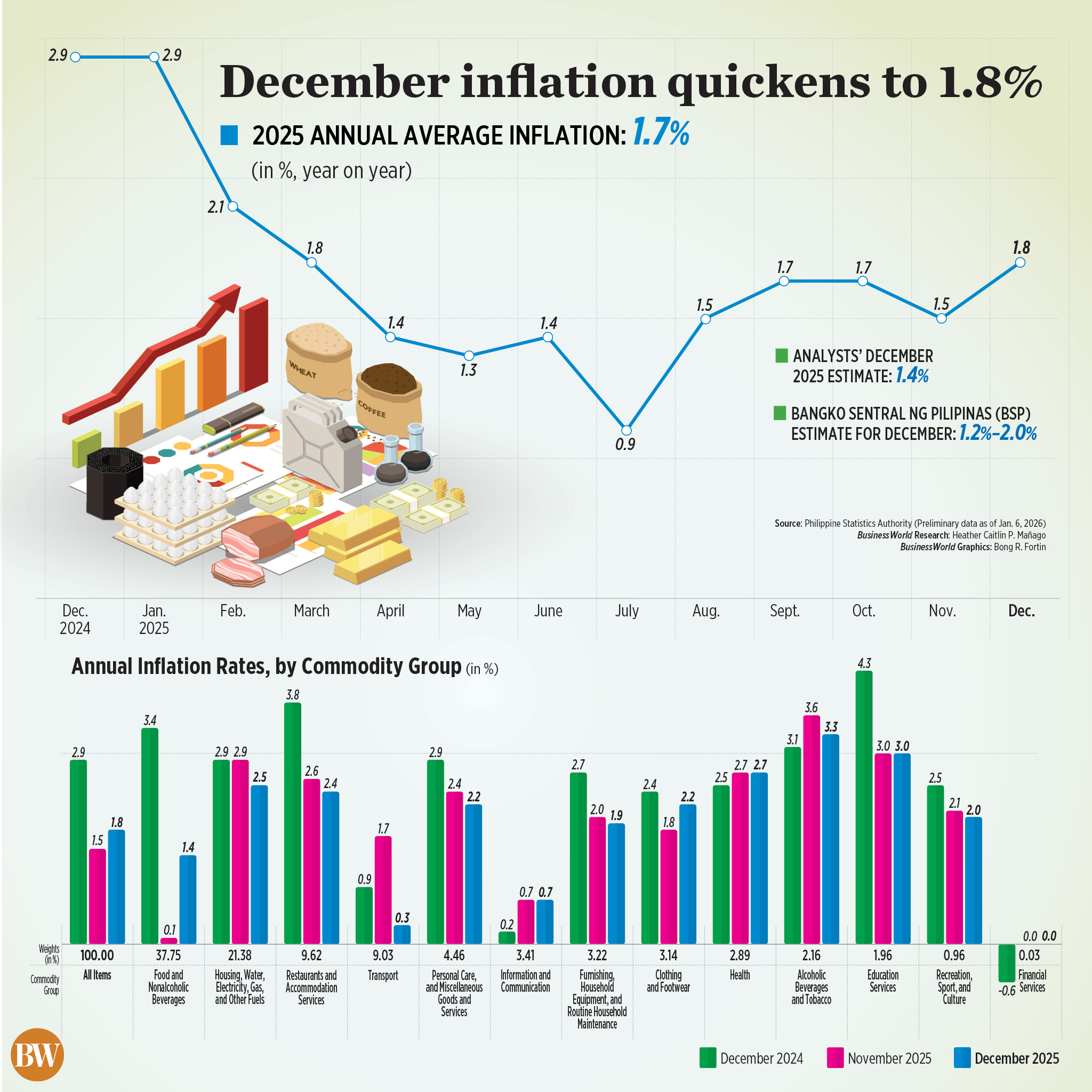
HIGHER FOOD PRICES during the holiday season lifted inflation to 1.8% in December, although the full-year average eased to 1.7% — the slowest in nearly a decade, the Philippine Statistics Authority (PSA) reported on Tuesday.
PSA data showed that last month’s consumer price index (CPI) quickened to 1.8% from 1.5% in November. Year on year, it slowed from 2.9% in December 2024.
December saw the fastest inflation since February or when inflation stood at 2.1%, but matched the 1.8% in March.
The latest CPI fell within the central bank’s 1.2-2% forecast for the month, but above the 1.4% median estimate in a BusinessWorld poll of 14 analysts conducted last week.
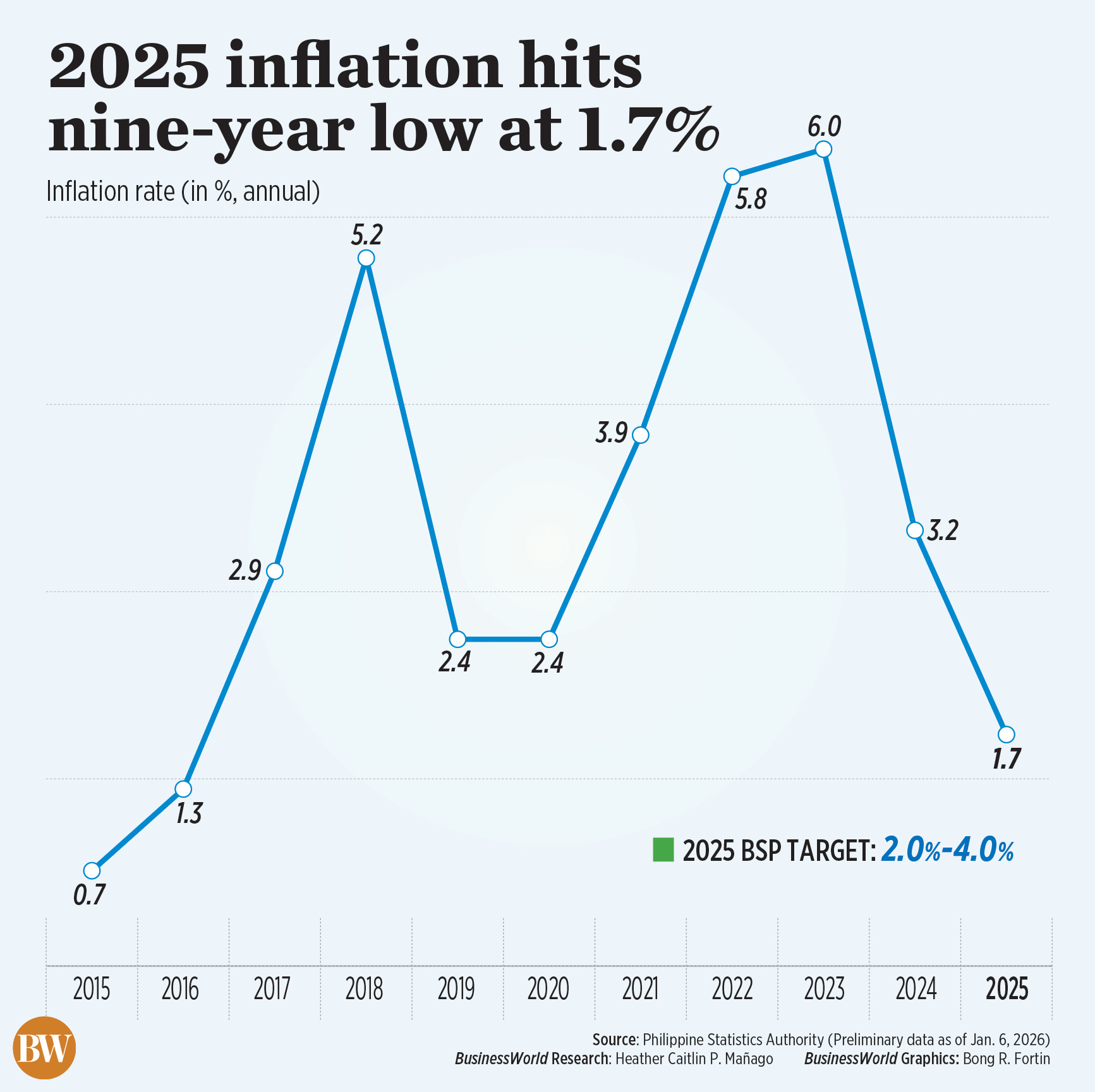
December marked the tenth consecutive month that inflation undershot the Bangko Sentral ng Pilipinas’ (BSP) 2-4% target.
The December print brought average inflation to 1.7% in 2025, easing from 3.2% in 2024. This was the slowest rate in nine years or since the 1.3% clip in 2016. It was also a tad above the central bank’s 1.6% estimate for the year.
“The major reason (for faster inflation) is really food, nonalcoholic beverages, particularly vegetables,” National Statistician Claire Dennis S. Mapa told a press briefing on Tuesday.
“(Prices of) vegetables and flour products rose. These are what we used for consumption in December, part of the holiday effect,” he added in mixed English and Filipino.
Inflation for the heavily weighted food and nonalcoholic beverages index accelerated to 1.4% from 0.1% in November amid faster price increases in cereals, cereal products, vegetables, tubers, fish and fruits.
According to Mr. Mapa, onion prices surged by 79% in December, followed by broad beans which rose by 41%, eggplants by 29.4%, okra by 28%, string beans by 24%, and tomatoes by 20.1%.
He also attributed the costlier vegetables last month to weather disruptions in November.
In November, Typhoon Kalmaegi (local name: Tino) battered parts of the country, leaving the local agricultural sector with about P2.5 billion in losses.
Rice deflation eased to -12.3% in December from -15.4% in the previous month. This was the slowest decline in rice prices in eight months or since -10.9% in April.
In mid-December, the average price of regular milled rice declined by 14.05% year on year to P42.10 per kilo from P48.98 per kilo previously, based on PSA data. Well-milled rice likewise fell by 9.9% year on year to P49.53 per kilo, while special rice fell by an annual 7.17% to P58.91 per kilo.
The National Government extended the suspension of regular and well-milled rice imports until end-2025.
CHEAPER ELECTRICITY, FUELMeanwhile, lower electricity and fuel prices during the month offered some relief, with inflation for housing, water, electricity, gas and other fuels slowing to 2.5% from 2.9% in November.
In December, the Manila Electric Co. (Meralco) lowered electricity rates by P0.3557 per kilowatt-hour (kWh) to P13.1145 per kWh from P13.4702 per kWh in November. This was equivalent to a P71 decrease in the monthly electricity bills of households consuming an average of 200 kWh.
Pump price adjustments in December recorded a net increase of P0.80 per liter for gasoline. However, prices of diesel saw a net decrease of P3.80 per liter, while kerosene posted a net decrease of P4.40 per liter.
PSA’s Mr. Mapa noted that the holiday-driven pressures may signal that the inflation spike in December was seasonal and temporary, adding that he hopes “prices will go back down in January.”
“Despite global headwinds and domestic challenges, the Philippine economy has remained resilient against inflationary pressures due to the government’s timely and targeted interventions,” Economy Secretary Arsenio M. Balisacan said in a statement.
Finance Secretary Frederick D. Go said the Department of Finance is focused on implementing “necessary measures to keep inflation manageable and ensure that Filipino families are protected from price shocks.”
Meanwhile, PSA data also showed that core inflation, which excludes volatile prices of food and fuel, steadied month on month at 2.4% in December, but eased from 2.8% in the same month in 2024.
In 2025, core inflation averaged 2.4%, easing from 3% in 2024.
Inflation in the National Capital Region (NCR) cooled to 2.3% in December from 2.8% in November and 3.1% in the same month a year ago. This brought full-year inflation in NCR to 2.4% in 2025 from 2.6% in 2024.
Outside NCR, inflation picked up to 1.7% from 1.2% in November but eased from 2.9% in December 2024, bringing the full-year average to 1.5%.
Central Visayas saw the highest inflation rate at 3.8%, while the Bangsamoro Autonomous Region in Muslim Mindanao recorded a -1% deflation.
On the other hand, inflation for the bottom 30% of income households stood at 1.1% in December, reversing the -0.2% in November but slowed from 2.5% in December 2024.
In 2025, inflation for the bottom 30% averaged 0.3%, easing from 4.9% in the previous year.
FURTHER EASINGMeanwhile, the central bank noted that the December clip supported its benign inflation outlook for 2025 and the next two years.
“(The) 1.8% is a welcome number. It’s a reasonably low inflation rate,” BSP Governor Eli M. Remolona, Jr. told reporters during an event in Mandaluyong City on Tuesday.
Amid this, Mr. Remolona left the door open for another 25-basis-point (bp) reduction to the key policy rate in February, noting that economic data falling below their expectations may warrant further cuts.
“On balance, the Monetary Board views the monetary policy easing cycle as nearing its end,” the BSP said. “Any further easing is likely to be limited and guided by incoming data.”
The central bank has so far lowered borrowing costs by a total of 200 bps since August 2024, bringing the benchmark interest rate to an over three-year low of 4.5%.
For 2026, the BSP sees inflation accelerating to 3.2%, before cooling to 3% in 2027.
Chinabank Research projects faster inflation this year due to a low base effect from the 2025 as well as potential upticks in food and energy prices amid weather disruptions and geopolitical tensions.
“This 2026, we expect inflation to edge higher to around the midpoint of the target range, partly due to base effects from last year’s low readings,” it said in a commentary. “Still, barring new shocks, price pressures are projected to remain manageable moving forward.”
Chinabank Research said this gives the BSP room to trim its key rates this year to spur the economy.
Meanwhile, Rizal Commercial Banking Corp. Chief Economist Michael L. Ricafort said headline inflation will likely stay below target until February before rising to 2-3% by March.
“(This) could still justify future local policy rate cut/s that would match future Fed rate cuts in 2026, (which) could realistically happen in the latter part of 2026, as early as June 2026, based on the latest Fed Funds Futures,” he added.