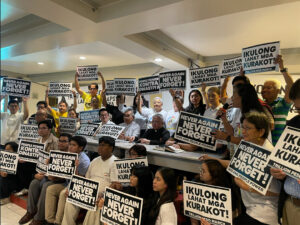

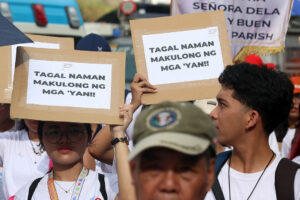
By Chloe Mari A. Hufana and Adrian H. Halili,Reporters
CORRUPTION risks in the Philippines’ 2026 national budget are shifting beyond infrastructure to health and education spending, a budget watchdog said, warning that weak safeguards during implementation could expose some of the government’s biggest social programs to political interference.
Social Watch Philippines said allocations approved by Congress for education facilities and health assistance warrant closer scrutiny as the P6.793-trillion General Appropriations Act moves from legislation to execution, particularly after a recent graft scandal involving public works projects.
“Corruption risks are not unique to infrastructure agencies,” Alce C. Quitalig, senior budget analyst at Social Watch Philippines, said via Viber. “The education and health sectors likewise contain questionable budget provisions that warrant close scrutiny.”
The group flagged funding increases added by lawmakers to the Department of Education’s basic education facility program beyond the agency’s original proposal, as well as allocations for the Department of Health’s (DoH) Medical Assistance to Indigent and Financially Incapacitated Patients approved at the bicameral conference stage.
President Ferdinand R. Marcos, Jr. signed the 2026 budget on Jan. 5 after vetoing P92.5 billion in unprogrammed funds. The spending law was passed amid heightened concern over corruption following revelations of misuse of public works funds.
One reform included in the budget was the removal of politicians’ guarantee letters for the DoH program, ending the requirement for endorsements to access hospital bill assistance. The DoH is set to issue revised guidelines by February to simplify procedures, widen coverage and reduce political influence in aid distribution.
Education again received the largest share of the budget, in line with constitutional requirements, with a record P1.345-trillion allocation. The health sector was allotted P448.125 billion, also its highest on record.
Corruption risks in these sectors are structural given the scale of procurement, logistics and documentation involved, said Hansley A. Juliano, a political science lecturer at the Ateneo de Manila University.
“Even during the 1990s, corruption and overpricing of procurement persisted, either to launder money or facilitate patronage,” he said via Facebook Messenger. He added that urgency in delivering health and education services creates pressure points where rules could be bent.
As implementation begins, Mr. Quitalig said the President has broad authority under the budget to enforce accountability, including the power to suspend or withhold expenditures when public interest requires. The challenge, he said, lies in enforcement.
The central issue is implementation — whether these provisions are enforced in good faith or circumvented, ignored or violated in practice, he pointed out.
Social Watch Philippines urged stronger citizen oversight, calling for wider use of budget monitoring, procurement observation, participatory audits, and transparency seal data. It also pushed deeper institutional reforms, including full civil society membership in the state’s bids and awards committees, passage of a Freedom of Information law, and a national budget transparency platform that tracks outcomes.
Despite existing safeguards, the group said restrictions on cash aid distribution and limits on political branding in government projects remain weak, warning that poorly framed implementing rules could entrench patronage practices if left unchecked.
Sustainable accountability, it said, depends on stronger enforcement by the Executive branch, sustained legislative oversight and active public participation in monitoring how funds are spent.
‘LEGISLATIVE CORRECTIONS’The Senate should begin examining projects that combine large budgets with weak oversight mechanisms, said Ederson DT. Tapia, a political science professor at the University of Makati.
“These include major transport projects with repeated cost overruns, digital and ICT (information and communications technology) systems procured under claims of innovation but shielded from scrutiny, and climate-related infrastructure where urgency often substitutes for accountability,” he said in a Messenger chat.
The Senate Blue Ribbon Committee could also look into social welfare programs and other forms of infrastructure, including public roads, said Anthony Lawrence A. Borja, an associate political science professor at De La Salle University.
“It should veer off to other public projects like social welfare programs,” he said via Messenger. “Looking into other forms of infrastructure would also be good, especially public roads.”
Mr. Borja added that the Senate body should take a broader approach and coordinate closely with government investigative bodies.
“If the Senate committee wants to show it is serious about accountability, investigations should be more comprehensive and in lock step the work of agencies like the Office of the Ombudsman,” he said.
The Blue Ribbon Committee has been investigating irregularities in flood control projects since August, following reports that government officials and senior lawmakers might have received multibillion-peso kickbacks from funds allocated for flood mitigation.
The hearings have become a key source of leads for the government’s anti-corruption drive, with testimonies used as bases for filing cases against officials and contractors.
Mr. Tapia said the Senate panel might already have fulfilled its fact-finding role on flood control projects and should begin wrapping up the inquiry.
“Closure should be accompanied by clear attribution of responsibility, documented referrals to enforcement agencies and a short list of legislative corrections,” he said. “Otherwise, ending merely becomes another form of forgetting.”
He warned that extended hearings could detract from the Senate’s legislative work, including reforms related to the budget process, climate adaptation and social protection.
“Excessive investigation can paradoxically weaken the capacity of Congress to correct what it has exposed,” Mr. Tapia said. “We should pay more attention to building and strengthening institutions.”
Joy G. Aceron, convenor-director of transparency group G-Watch, said the flood control investigation remains relevant but should now focus on policy failures.
“The Senate needs to start zeroing in on the policy issues that led to the plunder, since Senate hearings are in aid of legislation,” she said via Messenger.
She said lawmakers should examine weak accountability systems and how contractors exploit procurement rules, adding that both areas need legislative action.
Senator Panfilo “Ping” M. Lacson, who heads the Blue Ribbon Committee, said hearings are set to resume on Jan. 19.
The next hearing will tackle the so-called Cabral files, which allegedly detail budget insertions, infrastructure projects and kickbacks linked to flood control and other public works.