

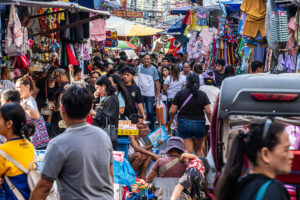
THE economic slowdown in the fourth quarter highlighted the Philippines’ over-reliance on consumer spending, in the absence of alternative drivers of growth, Bank of the Philippine Islands (BPI) said.
In a commentary on Wednesday, BPI Lead Economist Emilio S. Neri, Jr. noted that the performance in the final quarter of 2025 mirrored the issues that arose when the economy plunged during the COVID-19 pandemic.
“The economic slowdown reflects not only fiscal weakness, but also the country’s limited and highly concentrated sources of growth,” Mr. Neri said. “This is the same vulnerability that was evident during the pandemic.”
Household consumption continued to prop up the gross domestic product (GDP) growth, but Mr. Neri noted that such a sharp slowdown in the fourth quarter could have been averted if manufacturing and agriculture were robust enough.
“Even with the sharp decline in government construction spending, growth might have been more acceptable if the production sectors had been in a stronger position to offset the drag, specifically agriculture and manufacturing,” he said.
The economy posted its weakest quarterly growth in 16 years at 3% in the three months to December due to muted household consumption, government spending, and investments.
In 2025, GDP growth averaged 4.4%, the lowest in five years, the recent low having taken place during the pandemic and the resulting lockdown.
Household consumption growth, which accounted for over 70% of GDP, slowed to 3.8% in the fourth quarter, the weakest performance since the -4.8% reported in the first quarter of 2021.
Agriculture, forestry, and fishing grew 1% in the fourth quarter, accounting for 7.9% of the economy in 2025.
Industry growth declined 0.9% during the period, with manufacturing posting 1.6% growth. In the fourth quarter, industry accounted for 28.4% of the economy.
Mr. Neri said the Philippines needs more diversified sources of growth to help it weather economic shocks.
“The country cannot remain overly reliant on a narrow set of growth drivers such as consumption and government spending,” he said. “Even if public expenditure normalizes in 2026, the underlying vulnerability will persist unless the country broadens its sources of growth. A more diversified economy would be better equipped to absorb future crises and shocks.”
Still, Mr. Neri noted that quality government spending will be key in rebuilding investor and consumer confidence.
He expects growth of 5.1% in 2026, with the recovery likely to begin in the latter half of the year.
He sees scope for deeper monetary policy easing this year, citing the delayed economic rebound and within-target inflation.
“Meanwhile, the weak GDP print has increased the probability of a rate cut at the BSP’s next policy meeting,” Mr. Neri said. “With growth likely to remain weak in the first half of 2026, another cut could follow after a potential move in February, especially as inflation is expected to remain within target.”
Currently, the benchmark interest rate stands at 4.5%. The Monetary Board has so far lowered borrowing costs by a cumulative 200 basis points since August 2024.
If Mr. Neri’s anticipated two rate cuts materialize, the key policy rate could be brought to its lowest level in three and a half years at 4%.
The Monetary Board will have its first policy-setting meeting this year on Feb. 19. — Katherine K. Chan