

By Erika Mae P. Sinaking
THE Philippines’ youth workforce expanded and grew more digital in 2025, but rising unemployment and persistent gaps between available jobs and young workers’ readiness continue to test the country’s ability to turn its demographic advantage into sustained economic gains.
Youth participation in the labor force fell to 31.6% at end-November 2025 from 32.4% a year earlier, while unemployment in this group rose to 11.7%, or 744,000 unemployed young Filipinos.
Meanwhile, underemployment among the 5.62 million employed youth improved to 9.4% or 528,000 people, from 9.7% a year earlier. These figures show that while more young people are entering the labor market, many face persistent challenges in securing stable or full-time jobs.
Patrick P. Patriwirawan, Jr., director at the Department of Labor and Employment (DoLE) Bureau of Local Employment, said the rise reflects structural and seasonal factors, including school re-enrollment cycles, while highlighting why youth indicators remain central to labor policy.
“The surge in labor force entrants, especially fresh graduates and young people seeking employment, reflects increased participation,” he said by telephone. “Special employment programs have been more aggressively implemented in response.”
“This is brought about by the surge in new labor force entrants,” he said. “You see higher employment, but also higher unemployment, because more young people are actively seeking jobs.”
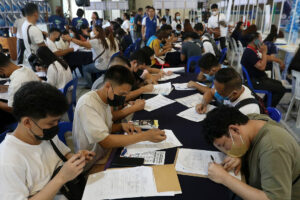
DoLE data point to a sharp expansion in youth employability initiatives last year. Under the Special Program for Employment of Students, registered youth participants rose to 151,000 in November from 102,000 a year earlier.
The Government Internship Program rose to 76,000 interns from 4,700. JobStart, another flagship youth employment initiative, more than doubled its reach to about 4,800 participants from 1,900 a year earlier.
“These numbers show that we intensified our implementation of youth employability initiatives,” Mr. Patriwirawan said. He added that interest in flexible and digital work arrangements has encouraged more young people to join the labor force.
Seasonality also shaped participation trends. Philippine Statistics Authority data showed the number of Filipinos attending school declined to 12.3 million in 2025 from 12.4 million a year earlier, a difference of about 87,000 who may have entered the labor market.
While school re-enrollment between June and August temporarily dampened participation rates, Mr. Patriwirawan said schooling is only one of several drivers of youth inactivity.
Beyond entry-level challenges, 2025 was marked by heightened concern over job displacement linked to automation and artificial intelligence (AI).
DoLE records showed that from January to November, 616,000 workers were displaced. Of these, 557,144 lost jobs due to retrenchment or workforce reduction, while 59,732 were displaced because of permanent business closures.
The most affected sectors were service activities, including computer and household goods repair, followed by construction and administrative and support services.
At the same time, labor demand remained visible. Vacancy postings on PhilJobNet reached 199,000 unique openings in November, led by manufacturing, information technology and business process management (IT-BPM), transport and logistics, wholesale and retail trade, and construction.
Tracking both displacement and vacancies helps identify where skill matching and employment facilitation are most needed, Mr. Patriwirawan said.
Despite fears that AI will eliminate jobs, labor and development stakeholders said technology presents more opportunity than threat if workers are prepared.
Maria Cristina L. Ibañez, national president at the Entrepreneurship Educators Association of the Philippines, said future youth employment would be “anything digital,” ranging from tech-enabled entrepreneurship to purpose-driven content creation.
“Digitalization is the way to go,” she told BusinessWorld in an interview. “But they have to navigate it well and be purposeful.”
James Russel B. De Vera, chief economic development specialist at the Department of Economy, Planning and Development, cited the growth of remote work and global clients, while warning that without faster action to generate local opportunities, skilled youth may continue to seek work overseas or online for foreign markets.
“If they have these [digital] skills, they will look for markets that demand them,” he said. “They will go somewhere else.”
Both Ms. Ibañez and Mr. De Vera said technical expertise alone is insufficient. Employers increasingly value soft skills and critical thinking.
“That’s what’s lacking now,” Ms. Ibañez said. “They know technical skills, but filling the gap — soft skills, empathy and critical thinking — that’s a big factor employers consider.”
Bridging regional and digital divides remains another challenge. While urban youth are more exposed to digital opportunities, Mr. De Vera cited government investments such as free public Wi-Fi, the National Fiber Backbone and satellite connectivity for public schools as steps toward inclusion. He added that the digital divide is shifting toward access to and use of AI tools.
From the private sector, Siklab Chief Executive Officer Saje Miguel Molato offered a blunt assessment of youth readiness.
Filipino youth have a global edge due to strong English proficiency, he said, but need stronger pipelines for skill development, entrepreneurship and local opportunities.
“If you’re a student now and you just plan to graduate with good grades, you’re not going to stand out,” he said, urging students to pursue internships, volunteer work and real-world experience.
He added that competitive workers need complementary or backup skills to stay employable if industries are disrupted by technological change.
The outlook for the youth workforce this year hinges on upskilling and investment in renewable energy, digital infrastructure, and IT-BPM services. Mr. Patriwirawan said labor market forecasts point to emerging roles such as AI and machine learning engineers, data scientists, robotic process automation architects and business intelligence analysts.
Meanwhile, traditional roles like customer service representatives and software developers remain in demand but are becoming harder to fill as employers seek specific micro-credentials and specialized certifications, he added.