

By Kenneth Christiane L. Basilio, Reporter
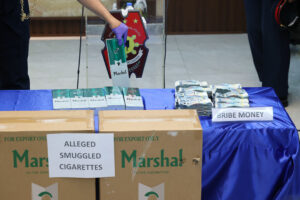
THE PHILIPPINE government’s excise tax collections on tobacco products have steadily declined in the previous years due to smuggling, Department of Finance (DoF) officials said on Wednesday, warning that unchecked illegal trade could undermine fiscal stability and jeopardize funding for public health programs.
Finance Undersecretary Karlo Fermin S. Adriano said the government collected P174.6 billion in excise taxes on tobacco products in 2021, but revenues have fallen by 24% to P132.26 billion in 2024, even as more Filipinos continued to smoke.
“Illicit tobacco trade is a direct threat to both our fiscal stability and our public health mandates,” Finance Assistant Secretary Euvimil Nina R. Asuncion told a House of Representatives hearing. “Every smuggled pack represents a direct theft from the healthcare funds.”
Excise tax collections fund a sizable share of the government’s health programs, but enforcement has long been a challenge in the archipelagic nation, where porous borders and proximity to neighboring countries make smuggling difficult to curb.
The Philippines applies an excise tax rate of P69.46 per pack of 20 cigarettes while vape products are levied with a P60.20 per milliliter (mL) tax for freebase nicotine and P69.46 per 10 mL tax for salt nicotine products, according to the excise tax rates prescribed by the Bureau of Customs for 2026.
“There’s a declining trend starting in 2022 until 2024,” Mr. Adriano said, noting that excise tax collections on tobacco products have dropped to P159.37 billion in 2022, P137.82 billion in 2023 and P132.26 billion in 2024.
Full-year data for 2025 is not yet available, but collections reached P122.15 billion from January to October.
The government may have lost as much as P172 billion in tobacco excise tax collections due to smuggling from 2020 to 2025, Philippine Tobacco Institute President Varinia Elero-Tinga said,
adding that as much as 20% of cigarettes sold are illegal.
That amount could have funded the construction of 58,000 classrooms, built 12,400 kilometers of farm-to-market roads, or provided P94 billion to support the government’s public healthcare program, her presentation to lawmakers showed.
Marikina Rep. Romero “Miro” S. Quimbo, who heads the House Ways and Means Committee, said recent government data showed more Filipinos have taken up smoking in recent years, with the rise in smokers likely driven by smuggling.
“In 2021, there were about 500,000 young people smoking. By 2023, that number had doubled to one million, with many already addicted,” he told the same congressional panel. “Among adults, the national survey showed that nearly four million new smokers were added in just two years.”
Despite the rise in the number of smokers and excise tax rates for tobacco, Mr. Quimbo noted excise tax collection from tobacco products has continued to decline. He said tax collections should have gone up alongside the increase in smokers.
Tax rates for cigarettes, heated tobacco and vape products are increased by 5% annually.
“Legal tax-paid cigarettes sell for around P125 to P200 per pack, while illicit cigarettes are selling for like P30 per pack,” Ms. Tinga said. “That’s like a 400% gap.”
Lawmakers should consider adopting a single excise tax rate for all electronic vape products. “The current structure creates a built-in incentive for misdeclaration,” she said, adding the tax gap entices manufacturers and importers to misdeclare cigarettes as vape liquids.
Authorities should also implement a minimum retail price for cigarettes to prevent tobacco companies from “artificially” declaring their products much cheaper to skirt tax obligations.
The Bureau of Internal Revenue (BIR) and Department of Trade and Industry (DTI) must coordinate by consolidating their database of registered vape producers and delisting those that failed to pay proper taxes in recent months to prevent them from selling in the country, Ms. Tinga added.
“BIR keeps a list of registered vape manufacturers and importers, while the DTI maintains a list of licensed vape importers,” she said. “The two agencies need to cross-check their lists.”