

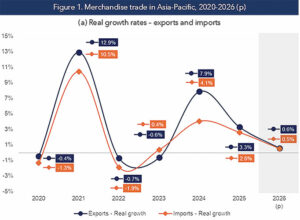
NOTE: (P) = PROJECTIONS.
By Witada Anukoonwattaka, Yann Duval, Nikita Shahu, and Niccolo Sainati
TRADE in the Asia-Pacific region has moved into a new strategic reality. The latest Asia-Pacific Trade and Investment Trends (APTIT) highlights that rapid technological change and a strategic reconfiguration of supply chains are reshaping how economies in the region trade and compete. Rather than pursuing cost efficiency alone, firms and governments are increasingly prioritizing supply chain resilience, diversification, and digital readiness. These forces are altering export performance, changing the geography of trade, and accelerating the rise of digitally driven goods and services across the region.
DIGITAL-LED TRADE GROWTHExport performance reflected this adjustment. Regional export growth slowed sharply from 7.9% in 2024 to 3.3% in 2025 (see the Figure). Additionally, persistent price compression, driven by weak global demand, excess supply, and falling commodity prices, pushed the region’s share of global exports down to 39%, extending a decline underway since 2021.
Across subregions, gaps widened. Growth is increasingly concentrated among economies able to capitalize on digital opportunities. South-East Asia and East and North-East Asia outperformed in merchandise trade, supported by their expanding roles in semiconductors, AI-related hardware, and advanced digital equipment. By contrast, exports contracted in South and South-West Asia where traditional industries remain the backbone of export structures.
A similar pattern emerged in services. In 2025, services exports rose by 5.4%, led overwhelmingly by digitally deliverable services such as ICT, telecommunications, computer services, and business and financial services. These are the functions that enable multinode production, data flows, and the coordination of increasingly complex supply networks. Traditional services such as travel and transport continued to grow but at a slower pace. East and North-East Asia again led regional services’ export expansion.
A SHIFTING GEOGRAPHY OF TRADEThe geography of trade is also evolving. For goods, geopolitical risk mitigation is playing a larger role in determining trade routes and partners. Intraregional merchandise trade remains significant with 53% exports and 56% imports, but its share edged down in 2025 as businesses diversified toward extra-regional markets. Export shares to the European Union and the rest of the world increased, while the United States became a rising destination for most subregions, with the exception of those most directly affected by geopolitical tensions.
Services trade remains more global, with only about 21% of services exports occurring within the region. However, ESCAP analyses point to gradually strengthening intraregional linkages. South-East Asia, for instance, has been redirecting a growing share of its services exports toward East and North-East Asia, reflecting that intra-regional demand for digital coordination functions is increasing within the services trade networks.
OUTLOOK FOR 2026Looking ahead, the outlook for 2026 remains cautious. Merchandise export volume growth is projected at around 0.6%. Developed economies’ exports are expected to contract by about 1.5% due to their exposure to high-tech supply chains under geopolitical strain and weaker demand in major markets. Developing Asian economies may show more resilience, but outcomes will hinge on China’s performance and the strength of global technological demand.
Services trade is expected to remain comparatively steady. Digitally deliverable services, especially ICT, computer and business services are likely to continue driving growth. Travel and transport may see gradual improvement, but several risk factors, including policy and regulatory uncertainty in digital trade, climate-related disruptions and increasing compliance burdens for MSMEs, cloud the outlook.
A STRUCTURAL SHIFTTogether, these developments point to a structural transformation in the region’s trade rather than a temporary cycle. On the goods side, firms are reengineering supply chains to build resilience by diversifying markets, relocating stages of production, and increasing the share of intermediate goods destined for assembly closer to end markets in the European Union and the United States. Yet this transition remains delicate: volumes have slowed, margins are compressed, and the region’s global export share continues to slip.
On the services side, digitalization is reshaping growth patterns. The strong growth of ICT, communications, computer and business services reflects the expanding role in supplying digital services, such as data management, logistics platforms ,and remote business services that keep modern supply chains running.
For Asia and the Pacific, particularly its developing economies, future gains will depend on pairing digital transformation with practical resilience strategies. ESCAP’s analyses drawing on RDTII and RIVA point to areas that deserve policymakers’ attention: persistent digital trade regulatory complexity and increasingly dense value chain connections that allow disruptions to spread widely. These trends underscore the importance of strengthening digital trade cooperation, as well as building resilient logistics and trade facilitation systems to keep intermediate goods moving reliably along supply chains. In this context, increasing participation by countries in the regional UN treaty on facilitation of cross-border paperless trade is a welcome development.
Witada Anukoonwattaka is the economic affairs officer, Economic and Social Commission for Asia and the Pacific or Escap. Yann Duval is the chief of the Trade Policy and Facilitation Section of ESCAP. Nikita Shahu is a consultant, at ESCAP while Niccolo Sainati is an intern.