

By Katherine K. Chan, Reporter
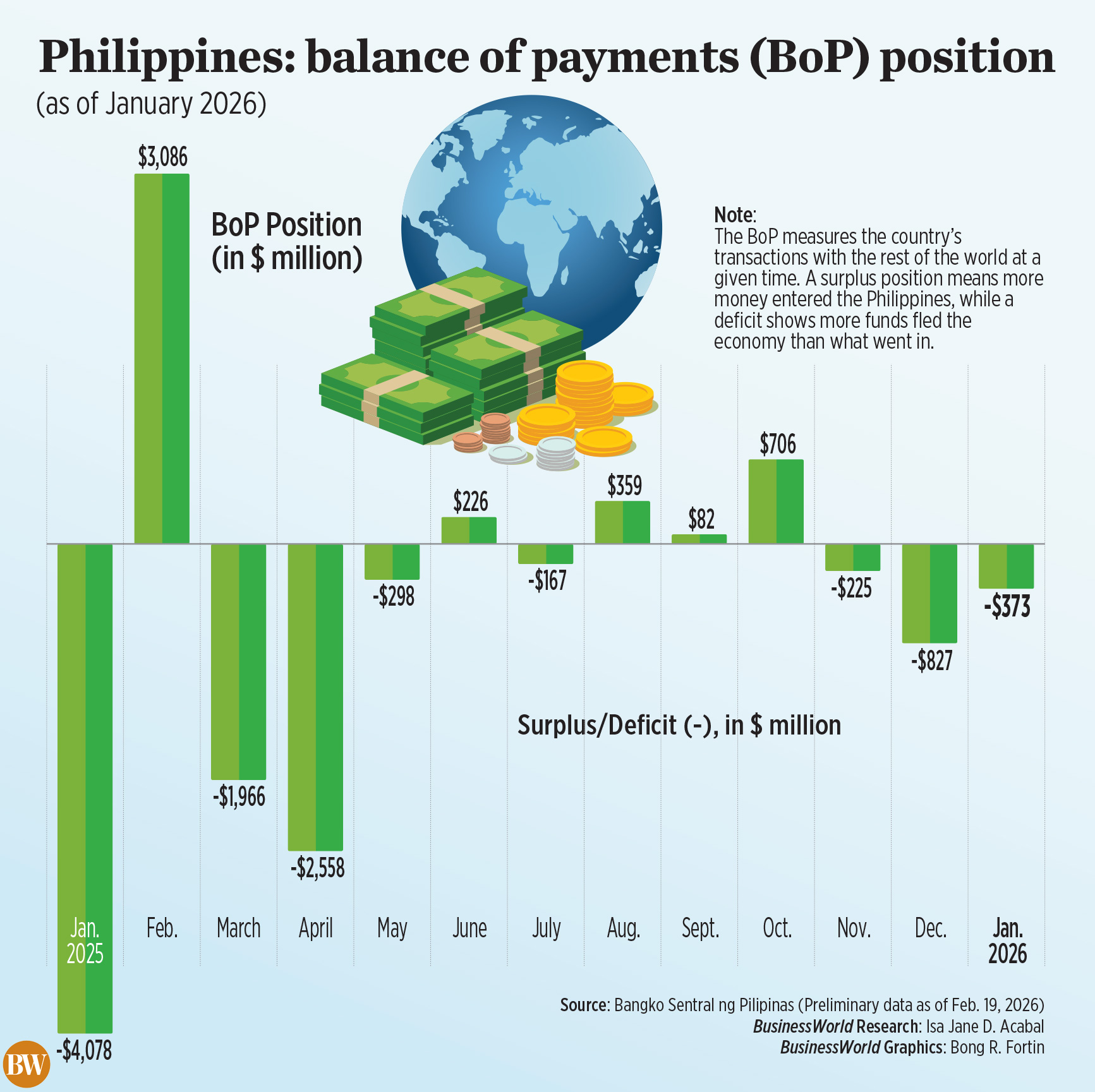
THE PHILIPPINES’ balance of payments (BoP) deficit sharply narrowed to $373 million in the first month of 2026, the Bangko Sentral ng Pilipinas (BSP) reported.
Based on central bank data released on Thursday, the country’s BoP position stood at a $373-million shortfall in January, sharply narrowing from the $4.078-billion gap recorded in the same month last year.
It was likewise smaller than the $827-million deficit posted in December 2025.
January also marked the third straight month that the country’s BoP position stood at a deficit.
BoP refers to the country’s economic transactions with other nations. A surplus indicates more funds entered into the country, while a deficit shows that the country spent more than it received.
“[The] deficit largely reflects seasonally strong import payments and profit remittances at the start of the year, alongside some portfolio repositioning amid global rate uncertainty,” SM Investments Corp. Group Economist Robert Dan J. Roces said in a Viber message.
Easing external pressures at the start of the year as well as steady inflows of remittances and services may have also driven the narrower deficit, he added.
Jonathan L. Ravelas, a senior adviser at Reyes Tacandong & Co., said the BoP deficit came on the back of the country’s persistent trade deficit.
“The BoP is still in deficit mainly because imports are outpacing exports,” he said via Viber. “That reflects strong domestic demand and infrastructure spending, while global demand for our exports — and services like BPO (business process outsourcing) and tourism — has been softer.”
Latest data showed that the country’s trade-in-goods deficit ended 2025 at its narrowest level in four years at $49.17 billion, down by 9.5% from the $54.33-billion shortfall logged in 2024.
However, Mr. Ravelas noted that the BoP deficit is “not a crisis signal,” noting that the Philippines’ external buffers are still solid.
“This isn’t a crisis signal; it’s a growth-related deficit, and our external buffers remain solid,” he said.
In the near term, the Philippines’ BoP position could remain at a deficit but may stabilize due to recovering exports, improving tourism and rising remittance inflows.
“In the coming months, the BoP should stabilize as remittance inflows rise and tourism receipts improve, though much will depend on oil prices, electronics exports, and the direction of US rates,” Mr. Roces said. “At this level, the deficit remains manageable and does not point to external vulnerability.”
Investment reforms may also provide some relief for the country’s BoP position, Mr. Ravelas added.
“The key now is to boost export competitiveness and attract more long-term investments, rather than overreacting to the headline number,” he said.
For this year, the central bank expects the BoP position to end at a deficit of $5.9 billion or -1.2% of the country’s gross domestic product.
16-MONTH HIGH RESERVESMeanwhile, the Philippines’ foreign reserves rose to their highest level in over a year at $112.6 billion at end-January.
This was the highest in 16 months or when the gross international reserves (GIR) level stood at $112.707 billion at end-September 2024.
Month on month, it climbed by nearly 1.6% from $110.833 billion in December.
In the first month of the year, the country’s GIR level translated to 7.5 months’ worth of imports of goods and payments of services and primary income, exceeding the three-month standard.
“Specifically, the latest GIR level ensures the availability of foreign exchange to meet balance of payments financing needs, such as for payment of imports and debt service, in extreme cases when there are no export earnings or foreign loans,” the BSP said in a statement.
It is also enough to cover about 4.1 times the country’s short-term external debt based on residual maturity.
GIR comprises foreign-denominated securities, foreign exchange, and other assets such as gold. It enables a country to finance imports and foreign debts, maintain the stability of its currency, and safeguard itself against global economic disruptions.
The BSP projects the Philippines’ dollar reserves to hit $110 billion by yearend.