
By Sheldeen Joy Talavera, Reporter
THE DEPARTMENT of Energy (DoE) has identified four potential sites in Luzon and Visayas that may house the country’s planned nuclear power projects, an official said.
Patrick T. Aquino, director of the DoE-Energy Utilization Management Bureau, said they have narrowed down potential sites from nine to four in consideration of the requirements of the International Atomic Energy Agency.
“The list has been narrowed to three to four sites: two on-grid in Luzon and two off-grid in Palawan and Masbate,” Mr. Aquino told BusinessWorld.
He said that these areas were considered due to its proximity to the available transmission point and the demand.
Under the Philippine Energy Plan, the country aims to integrate nuclear energy into the national power mix with at least 1,200 megawatts (MW) of capacity by 2032, doubling it to 2,400 MW by 2045 and to 4,800 MW by 2050.
The government sees the potential role of nuclear energy in diversifying the energy mix to meet emission reduction targets and enhance energy security.
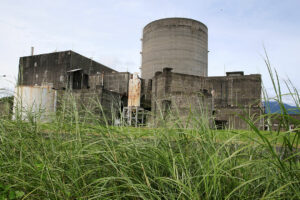
While nuclear energy seemed to be relatively young in the Philippines, the country built the Bataan Nuclear Power Plant but it has remained idle since 1986.
At present, the government is banking on the private sector to push the integration of nuclear energy into the country’s power generation mix. Last year, Energy Secretary Sharon S. Garin said the agency plans to accept applications for nuclear energy proposals by 2026.
In line with the goal, major energy players have already set their sights on this breakthrough.
According to Mr. Aquino, some of the energy firms that have expressed intent to develop nuclear energy technologies are Pangilinan-led Manila Electric Co. (Meralco), Aboitiz Power Corp. (AboitizPower), Razon-led Prime Infrastructure Capital, Inc., and Ang-led San Miguel Global Power Holdings Corp.
“They have attended meetings and participated regarding nuclear (energy development),” he said.
At the forefront, Meralco has already outlined its plans this year, including an adoption study for small modular reactors (SMRs) — a technology smaller than conventional nuclear plants.
Meralco recently secured a $2.8-million grant from the United States Trade and Development Agency to advance its feasibility study on SMR.
AboitizPower, on the other hand, has entered into a public-private partnership to support workforce development.
These are among the deals the Philippines has secured in partnership with US government agencies and companies to support the former in its goal of nuclear power integration.
“We asked them (energy companies) what they need from government or what does the government has to fix and they were all: ‘independence,’” Ms. Garin said during the signing on Feb. 16. “For that, I assure you, our companies are eager to embark on a nuclear program in the Philippines.”
Alpas Pinas Lead Convenor Gayle Certeza said the initiative of major corporations and universities looking into offering nuclear engineering programs is a big step in going into nuclear energy.
“Although all these constitute a big shift, we still have a long way to go. Other countries have been using nuclear energy for decades. We still have to start ours,” she said in an e-mail interview.