

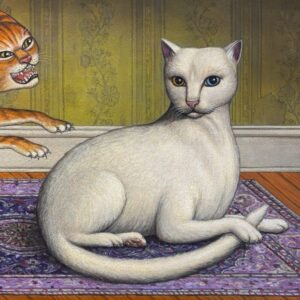
By Brontë H. Lacsamana, Reporter
Album Review
Nothing’s About to Happen to Me
Mitski
Dead Oceans, Inc.
A LOT of time has passed since the late 2010s, when Japanese-American musician Mitski was an indie darling among depressed millennials grappling with the initial pangs of adulthood.
Come 2023, no one would have predicted that she’d find commercial success with her slow lounge ballad, “My Love Mine All Mine,” which introduced her to top 100 charts and was used in millions of TikTok videos. Mitski would be the last person you’d expect to have a kind of teen pop following, and her eighth and latest album reflects that.
Produced and engineered by Patrick Hyland and mastered by Bob Weston, Nothing’s About to Happen to Me is an apt continuation of her contemplative and organic-sounding 2023 album The Land Is Inhospitable and So Are We. This time, there’s more theatrical fanfare as she utilizes more ensemble and band arrangements.
Filled with thoughts on loneliness and delusion, the album is centered on the persona of a reclusive woman. In her chaotic yet liberating home, we get a peek into her solitary journey of self-discovery — the perfect avenue for Mitski to showcase her distinct, hauntingly beautiful style of music.
“I’d never live in a small town. I’ve made too many mistakes,” she begins in the album’s first track, “In a Lake.” Her forlorn voice is familiar and soft amid the gentle Americana sounds of the banjo, accordion, and double bass. Towards the end, a somewhat crazed, grandiose ending is ushered in by the horn section along with city noises (“And in a big city, you can start over / The lights all around you, the dark safe in the sight”), breaking the illusion of a romanticized, isolated life.
The next track is the album’s straightforward rock song, “Where’s My Phone?” Here, the lead single presents gritty guitars as Mitski’s frantic vocals repeat a search for her lost phone, or her lost self. The energy it gives off is akin to the punk anxiety found in her 2014 album Bury Me at Makeout Creek, which is a treat for longtime fans.
“Cats,” the third track, goes back to a steady pace. With heart-rending lyrics about her cats making up for the absence of a lover, Mitski adds the right amount of texture to the song, thanks to a subtle string arrangement complementing the thrum of the guitar and drums.
The fourth track, “If I Leave,” is a standout. It expresses dependence on a lover and the raw desolation felt without them, bringing back the emo sensibilities of her 2016 album Puberty 2. With fuzzy, heavy guitars, it’s a big, slow track that’s truly cathartic.
“Dead Women” follows with a darker, lonelier tone as Mitski sings of a woman’s morbid imagining of how loved ones would remember her after her death. Here, she is lyrically in top form: “Ransack the house for what you’ll auction, what you’ll keep / Then embalm me up ’cause you’re hosting the viewing / Saying, ‘She gave her life so we could have her in our dreams’ / ‘She gave her life so we could fuck her as we please.’”
The sixth song, “Instead of Here,” is sad and slow. It’s a simple track, but just as emotionally effective, as the lyrics express the preference of being alone rather than the pain of living with others.
A similarly mid-tempo track follows, possibly the best of the album. “I’ll Change For You,” another single, showcases equal parts desperation and restraint in Mitski’s sung love confession, supported by lush, bossa nova-style instrumentation. Here, she celebrates the allure of idling at a bar, where there are many people to be with yet no one at all. “So I’m loitering outside / Watching all the cars passing by / Like a kid waiting for my ride,” she sings.
She also gives us an upbeat anthem with “That White Cat,” bringing back her punk sound from the mid-2010s. With a thrashing guitar and angry vocals, the drama of a white cat marking her house as its own plays out with fervor and escalates.
“Gotta go to work / To pay for the cat’s house / For the red-corseted wasp / Who lives in the roof / For the family of possums / For the bugs who drink my blood / And the birds who eat those bugs,” she sings.
The second to the last song is “Charon’s Obol,” where Mitski evokes a bit of 1950s blues and country. The moody tune takes on the spirit of Charon, the ferryman to the afterlife in Greek mythology, as the lyrics detail taking care of a dead woman’s pet hounds.
“Lightning” closes the album, steady in its slow indie rock reckoning with the concept of death. Mitski’s raw voice again leaves an impact atop the rollicking instrumentation.
“I can hear the song of my death / Singing for the lightning to come / Calling to the thunder, ‘Polo,’” are the final words of the album.
The rich inner world found in Mitski’s music fills the mind as each track ends and makes way for the next. Her artistry remains as potent as ever, reflecting a world that keeps on spinning whether something big befalls us or not — ultimately, a wry admission of heartbreak as well as a true comfort.
Nothing’s About to Happen to Me is out now on all music streaming platforms.