

AUTHOR Carmen Guerrero Nakpil was supposed to have been the one who coined the phrase “300 years in a convent and 50 years in Hollywood” as a description of Philippine history under Spanish and American colonial rule. For half that time under the Americans, the Philippines was clothed in the beauty that was the Art Deco style.
The design style originated in the Exposition internationale des arts décoratifs et industriels modernes in Paris in 1925 (thus it just celebrated its centennial). To mark the occasion, the National Museum of the Philippines opened an exhibition of Art Deco in the Philippines in November last year, running until May 31 of this year.
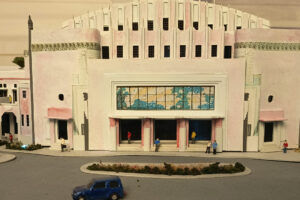
The exhibition, titled Art Deco: Modernity and Design in the Philippines 1925-1950, collects examples of Art Deco and emphasizes its pervasiveness. It’s easy to think of its popular design styles as influencing architecture (seen in photographs and scale models in the exhibit) but the style is also seen in stationery, furniture, clothes — and even in the way we approach religion.
For example, the exhibition greets visitors with bas-reliefs taken from the facade of the Capitol Theater, built in 1935. A timeline also establishes the arrival of Art Deco in the Philippines. While arriving to the rest of the world via Paris, it reached our shores secondhand through our colonizers. While Art Deco as a style, as we mentioned, began in 1925 and was overtaken by other styles by the end of the 1930s, the timeline in the National Museum of Fine Arts extends before and after the heyday of Art Deco. It extends farther back in time to reflect American laws and policies that made it possible to build, import, and manufacture in the style that dominated its home base, while the timeline extends after to reflect a nation scarred by war, building with the bones it had been left with.
The exhibit cites the first expression of Art Deco in the Philippines as The Chapel of the Crucified Christ at St. Paul College in Manila, featuring hints of Art Deco juxtaposed with tropical-Gothic themes. Prominently featured in the exhibition is the Manila Metropolitan Theater, built in 1931. It survives today as one of the finest examples of Art Deco architecture in the Philippines — a fate not shared by many buildings built in the period. For example, while the exhibition also celebrates the Manila Jai Alai building, it did not survive to the present day — not due to the Second World War (the exhibition notes the wartime damage taken by other Art Deco landmarks such as the aforementioned theater, the Rizal Sports Complex, Quezon Bridge, and the Crystal Arcade shopping center), but due to bureaucracy and the passage of time — the building was demolished in 2000 by then Manila Mayor Lito Atienza, despite an intense effort to save it, to make way for a new Manila Hall of Justice (which was never built).
Another gallery housing the exhibit (which takes up galleries VII and X) moves past architecture and goes on to show the design style in everyday life. Ternos and Filipiniana dress show the bold, vibrant patterns that made Art Deco distinct. The dresses from the collections of prominent women of the period: think ternos worn by Aurora Quezon, the country’s First Lady then.
Everybody has a little piece of Art Deco in their homes apparently: more than the items from prominent people of the era (check the dressing table owned by Aurora Aquino, the mother of politician then hero Benigno “Ninoy” Aquino, Jr.), some of the items are on loan from regular Filipinos like writer Jose “Butch” Dalisay, Jr., for example, who lent pens and stationery indicative of the period.
Notes at the exhibition said, “Art Deco flourished at a crossroads of history when Filipinos were longing for asserting a nationalist identity while embracing modernity in a Western colonial milieu.” Erased by war, it bore witness to new styles: mid-century modern became popular here too, but it could be argued that in architecture, the next most prominent style in the Philippines was Marcos-era Brutalism. The exhibit thus gains a sort of wistfulness: more than showing what the Philippines was, there’s almost a sigh in thinking what else it could have been, before the glamor of that era was lost to war, then successive generations of corruption. — Joseph L. Garcia