
By Sheldeen Joy Talavera, Reporter
THE PHILIPPINES may not be able to hit its renewable energy (RE) targets on time due to grid constraints and challenges in securing permits, according to S&P Global.
Vince Heo, director of Asia-Pacific Power and Renewables Research at S&P Global, said that RE’s share in the national power mix may only reach 27% in the next four years and 50% by 2050.
“We are making a forecast. It’s our own view. It’s not based on our base case,” Mr. Heo told reporters on the sidelines of an event in Makati City on Wednesday.
S&P Global’s latest forecast falls short of the Philippines’ target to raise the share of renewables in the power generation mix to 35% by 2030 and 65% by 2050.
RE accounts for 25% of the country’s energy mix.
Coal still dominates the energy mix but the Philippines is trying to move away from fossil fuel and tapping renewables to have a cleaner and more sustainable source of power.
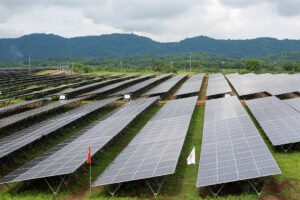
The Department of Energy (DoE) has been launching a series of green energy auctions (GEAs) to entice more developers to harness renewable energy sources, which has so far promised around 20 gigawatts (GW) of potential capacity.
Despite this, Mr. Heo said that there is still “a big gap” between the government targets and the green energy auction.
“They always disclose a very big number but when let’s say the GEA-4 was announced, we discounted the actual capacity to be installed knowing that there will be challenges in meeting all these targets,” he said.
“Let’s say all these solar projects, seven gigawatts are all operational, there’s an issue with dealing with this intermittency from solar and there’s not enough storage in the power grid,” he added.
Mr. Heo said this would likely push the country to rely more on “firm capacity” from coal and gas, which can provide round-the-clock power.
Earlier this year, the National Grid Corp. of the Philippines — the country’s sole grid operator — has called for “a more incisive and progressive policies” on the entry of variable renewable energy to ensure grid stability.
At the same time, Mr. Heo pointed out that the cost of financing a project in the Philippines is higher than in other countries.
“I think [the Philippines has] a WACC (weighted average cost of capital) estimation of about 10-11% for solar project which is about 3-4% higher than the other markets and that’s a big portion of your project,” he said.
Mr. Heo said the Philippines has higher country risk, making it difficult for international banks to finance projects in the Philippines.
“A lot of things on the government regulation, uncertainties in the transmission, etc. It’s much more clear and visible in other advanced markets than the Philippines,” he said.
Mr. Heo said the DoE’s termination of RE contracts is “good news,” as it shows the government is committed to transparency.
“I think it’s good that the government came out and announced this news so that everyone knows what’s happened and the consequences of not meeting the timeline,” he said.
The DoE earlier said it has terminated and relinquished 163 RE contracts, which is equivalent to nearly 18 GW of potential capacity, due to the failure of developers to implement these projects.
Also, Mr. Heo said the Philippines is attracting more foreign interest after it opened its RE market to 100% foreign ownership.
“Philippines is an interesting market, but definitely the government lifting the foreign ownership restrictions was a good trigger. We see a lot of foreign developers and investors now interested in the Philippines market,” he said.
Meanwhile, Avril de Torres, deputy executive director at think tank Center for Energy, Ecology, and Development, said that failing to meet the RE targets “is certainly a possible scenario for the Philippines.”
She said that this is due to the government’s policy directions that allow coal, gas, and other “detrimental energy sources” to crowd out renewable energy, rather than be displaced by it.
“The government must ramp up support for distributed and community-based RE initiatives to help take advantage of this untapped potential, such as through incentives and concessional financing,” Ms. De Torres told BusinessWorld.