
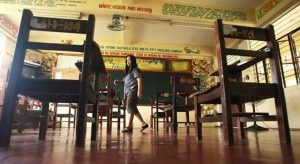
THE Department of Education (DepEd) on Monday said that it is looking to construct 30,000 new classrooms from 2026 to 2028, to address the country’s growing gap in learning facilities.
During a Senate hearing, Education Undersecretary Ronald U. Mendoza said that the agency is aiming to complete the construction of new classrooms by the end of 2028.
“This will be through conventional procurement, it is up to our ambition and our partners to put more resources on this,” he told senators, in mixed Filipino and English.
Mr. Mendoza said that the Education department is looking to pivot from conventional procurement methods in constructing classrooms to public-private partnerships (PPPs).
“This (target) can be changed. We are working very closely with our economic team to see where the fiscal space can be directed whether it is conventional procurements or PPPs,” he added.
DepEd has also secured funding to construct about 16,000 new classrooms under the Public-Private Partnership for School Infrastructure Project (PSIP), which is now being prepared for bidding.
He added that the agency is also looking to lease or acquire about 1,000 locations that would serve as public school classrooms.
“This could potentially be a game changer in places where there are no more buildable spaces but have unused properties,” he said.
The country faces a growing classroom deficit estimated at over 165,000, which would take at least 55 years to fill based on estimates by the Education department.
“Every year there is an additional 10,000 classrooms worth of kids potentially entering our system. Every year, on average, there are an additional 4,000 schools damaged by typhoons and floods, so the target is moving,” Mr. Mendoza added.
At the same hearing, the Second Congressional Commission on Education (EDCOM II) said that the government must prioritize classroom construction for Kinder to Grade 3 students.
“We must address backlogs in Kinder to Grade 3 first, as congression here severely impacts early literacy,” EDCOM II Chief Legal Officer Simoun M. Salinas told senators.
He added that there is a need for better collaborations with local government units and nongovernmental organizations for classroom construction.
“The status quo is not working fast enough for our students. The classroom shortage is a national emergency that requires more than traditional procurement,” Mr. Salinas said.
Senator Paolo Benigno A. Aquino IV, who heads the Senate Education panel, said that at least 26,000 new classrooms must begin construction this year.
“What we see is that we need anywhere from six to 10 years of high, continuous funding to address the problem,” he added.
Mr. Aquino said that there is also a need to implement a uniform pricing policy for the construction of new classrooms.
“It is important that we see that this funding is used to build classrooms at the right price, in the right way, and at the right time,” he added.
The government has earmarked about P67.9 billion for the construction of new classrooms under the 2026 national budget. — Adrian H. Halili