

Our economic managers and trade officials may well succeed in attracting sizeable foreign investments as we chair ASEAN in 2026. But without structural reform — in infrastructure, institutions, and policy frameworks — such efforts address the periphery, not the core. The more fundamental question remains: how do we motivate risk-averse investors when growth dynamics, weighed down by corruption and patronage politics, remain fragile? When even macroeconomic policy appears to be reaching its limits?
Accommodative monetary policy is pushing on a string. Weak business and household confidence blunt its impact, while banks, acting procyclically, tighten credit standards and weaken the transmission channel. The recent policy rate cut, instead of inspiring confidence, underscored economic fragility. As we noted in GlobalSource, the reduction “reflects both accommodation and caution” — a wake-up call to Malacañang and Congress to do more than rely on the central bank.
Expansionary fiscal policy can lift growth only if infrastructure funds are protected from plunder and truly directed toward productive investment. Of the P243 billion in unprogrammed appropriations, only P93 billion was vetoed. Some of the vetoed items could have funded P35.7 billion in counterpart financing for foreign-assisted projects. Where, then, do the remaining items go? Without discipline, fiscal consolidation becomes rhetoric and debt sustainability drifts further away.
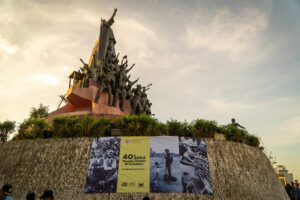
This is why EDSA at 40 matters.
Had even a fraction of EDSA’s moral and political intent been institutionalized, the Philippines could have traveled a very different economic path.
The 1986 EDSA People Power Revolution was not merely a political transition; it was a reset of public expectations. It was a collective rejection of impunity, cronyism, and entitlement. It sought to restore rule of law, accountability, and the primacy of institutions over personalities. Had those aspirations been translated into sustained structural reform, growth would not have depended on episodic booms or remittance-driven consumption. It could have been broad-based, productivity-driven, and institutionally anchored.
If Congress had faithfully implemented the 1987 Constitution’s prohibition on political dynasties, political competition would have deepened. Governance could have shifted from patronage to programs, from transactional politics to policy-based accountability. Political capital would have been earned through performance rather than inherited through lineage. That single reform alone could have altered the country’s incentive structure — encouraging long-term policymaking instead of short electoral cycles.
If constitutional accountability institutions — the Office of the Ombudsman, the Sandiganbayan, and the Commission on Audit — had been strengthened not only in mandate but in operational independence, the deterrent effect on corruption could have compounded over time. Faster resolution of cases, higher conviction credibility, and visible enforcement would have lowered the risk premium attached to the Philippines. Obviously, investors prize good governance. But citizens do more.
If the civil service had been fully professionalized, shielded from patronage appointments and reinforced by meritocratic promotion, the regulatory environment would have matured earlier. The result could have been policy continuity that is less vulnerable to political turnover. We only have to set our sight to such countries as Singapore and Hong Kong which demonstrate that strong bureaucracies are not luxuries; they are growth infrastructure.
Why, even within constitutional economic restrictions, consistent enforcement of competition law, anti-monopoly provisions, and independent regulation could have fostered a genuinely level playing field. Capital does not merely seek openness; it seeks predictability and fairness. A rules-based economy reduces uncertainty, and invites more investments, more effectively than any tax incentive package. Other territories offer similar incentives but more even playing field.
In other words, the Philippines did not lack potential. It lacked sustained institutionalization of EDSA’s moral impulse.
Had governance credibility strengthened over the decades, fiscal multipliers would have been larger, infrastructure spending more efficient, and monetary easing more effective. Confidence — arguably the most powerful economic variable — would have been endogenous, not episodic. Growth could have compounded not only through capital accumulation, but through higher institutional trust.
We often measure lost opportunity in terms of foregone GDP percentage points. But the deeper loss is compounding credibility. Four decades is enough time for institutions to mature, for corruption norms to shift, for political culture to evolve.
That this transformation remains incomplete is precisely why the promise of EDSA still feels aspirational rather than fully realized.
The lesson is not nostalgic. It is structural: when moral reform is only commemorated but not embedded, economic reform could only remain fragile.
Remember the recent warning from Fitch Ratings?
It has warned that the Philippines is among the most vulnerable to climate-related risks, something that most of us already know but very few care about. Yet some of our politicians without shame plundered public money away from flood control projects for years, depriving many of the exposed communities of climate defense and escalating fiscal and economic costs. Resources meant to flood-proof communities reportedly financed private excess instead. Climate vulnerability thus becomes both an environmental and governance crisis.
Against this backdrop, Moody’s Ratings projects growth of 5.5% in 2026 and 5.6% in 2027 — figures hedged by concerns over debt servicing costs, revenue needs, and restrained public spending. These are not breakout numbers; they suggest muddling through. Especially when growth was stronger in 2024 and slowed markedly thereafter, “rebound” feels optimistic.
Moody’s expects resilient consumption and recovering public investment. Yet it acknowledges risks and time lags. It also overlooks the reality that weak monetary transmission and procyclical banking behavior can blunt policy support, while fiscal consolidation remains gradual at best.
It is comforting to say the Philippines has nowhere to go but up. But numbers alone do not constitute progress. Without moral integrity in policy design and implementation, reforms lose credibility before they bear fruit.
Chairing ASEAN in 2026 offers symbolic leadership. But institutional reform is substantive leadership. Without the latter, the former risks becoming ceremonial.
Looking back, 40 years after the 1986 EDSA People Power Revolution, the challenge is not remembrance. It is completion.
Now, we need the Trillion Peso March to deliver that message.
As Lipa Archbishop Gilbert Garcera, also president of the Catholic Bishops’ Conference of the Philippines (CBCP) warned, the deeper danger is moral fatigue. And moral fatigue is not abstract. It seeps into institutions, into regulatory discretion, into budget processes, into the uneven enforcement of law. When accountability weakens, risk premia rise. When impunity persists, capital hesitates. When public trust erodes, even the best-designed policies operate below capacity.
We can celebrate improving forecasts from Moody’s Ratings or note cautions from Fitch Ratings. But ratings agencies cannot manufacture credibility. Central banks cannot print integrity. Fiscal expansion cannot compensate indefinitely for governance leakages.
The tragedy is not that EDSA failed. It is that it was not fully finished. Even after 40 years.
Unless we keep our feet firmly on the ground — anchored in reform, rule of law, and moral responsibility — economic projections will remain arithmetic without architecture. Growth without integrity is fragile. Numbers without institutional reform are merely numbers.
The real unfinished business of EDSA is not memory. It is governance.
Diwa C. Guinigundo is the former deputy governor for the Monetary and Economics Sector, the Bangko Sentral ng Pilipinas (BSP). He served the BSP for 41 years. In 2001-2003, he was alternate executive director at the International Monetary Fund in Washington, DC. He is the senior pastor of the Fullness of Christ International Ministries in Mandaluyong.